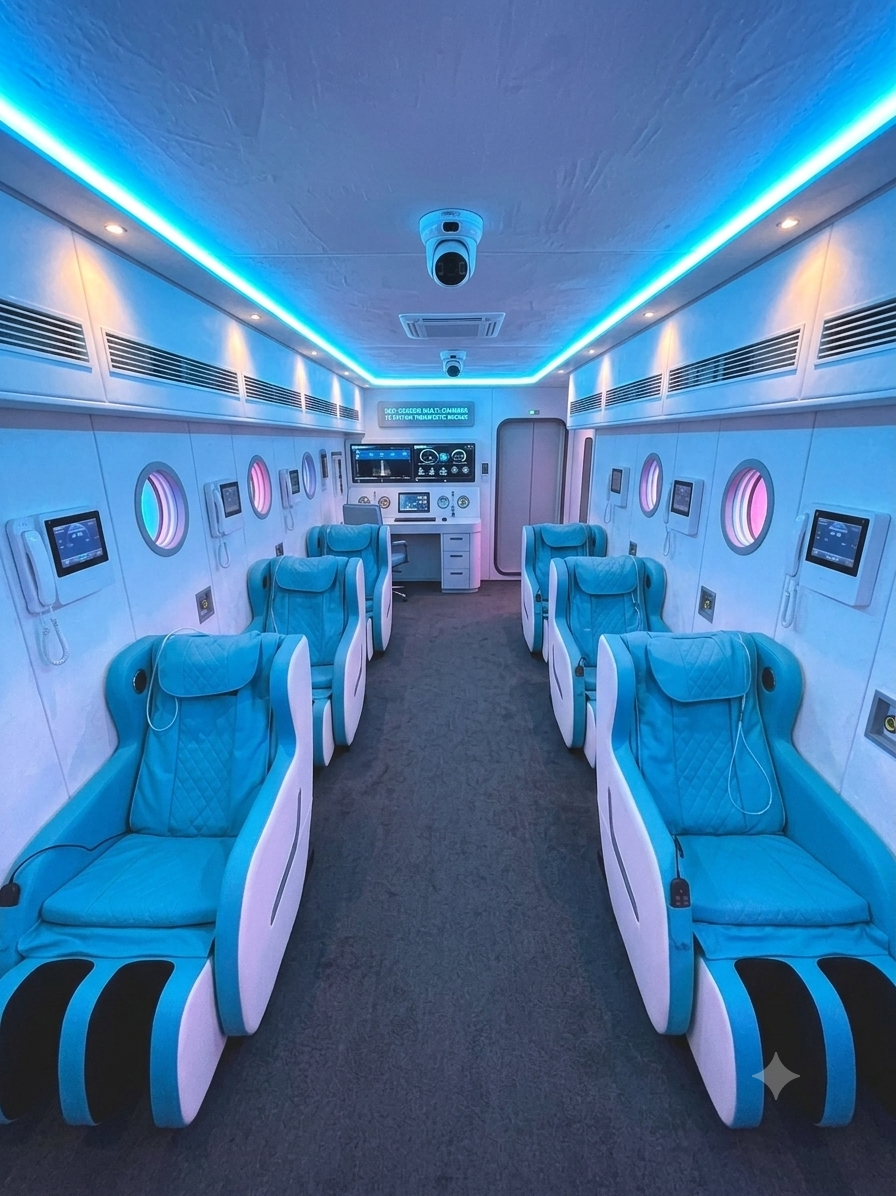
A rapid decompression chamber is a specialized pressure vessel that simulates sudden cabin pressure loss at high altitude, allowing pilots and aircrew to experience hypoxia and other physiological effects in a controlled environment. Unlike hyperbaric chambers used in diving medicine, these aerospace training devices decrease pressure rapidly to replicate emergency conditions.
This overview covers how the chambers work, what happens to the body during rapid decompression, the differences between chamber types, and why this training matters for aviation safety.
What Is a Rapid Decompression Chamber
A rapid decompression chamber is a sealed pressure vessel used in aerospace medicine to simulate what happens when an aircraft suddenly loses cabin pressure at high altitude. The chamber works by rapidly dropping internal pressure, which allows pilots and aircrew to experience the physiological effects of altitude in a controlled, supervised environment.
You might have heard the term “decompression chamber” in the context of scuba diving, but the two are actually opposites. Diving chambers (hyperbaric chambers) increase pressure to treat conditions like the bends. Aerospace decompression chambers decrease pressure to mimic high-altitude emergencies.
The typical rapid decompression chamber has two connected compartments: a main compartment where trainees sit, and a smaller decompression tank. When operators open a valve between the two, air rushes out of the main compartment almost instantly. That sudden pressure drop is what creates the training experience.
How a Rapid Decompression Chamber Works
1. Pressurization of the main compartment
The process starts with trainees entering the main compartment through a sealed door. Operators then pressurize the space to simulate a lower altitude, essentially recreating the cabin environment of a pressurized aircraft during normal flight. Think of it as setting the baseline before the emergency simulation begins.
2. Vacuum buildup in the decompression tank
While trainees get comfortable in the main compartment, vacuum pumps are working on the adjacent decompression tank. The pumps remove air from the tank, creating a much lower pressure that represents a higher altitude. The difference in pressure between the two compartments is what makes the rapid decompression possible.
3. Rapid pressure equalization and altitude simulation
Here’s where the training event happens. Operators open the connecting valve, and air rushes from the main compartment into the evacuated tank. The whole thing takes a fraction of a second.
Trainees feel an immediate rush of air, a sudden temperature drop, and often see fog form as moisture in the air condenses. The sensation is startling even when you know it’s coming, which is exactly the point.
In aerospace terminology, “explosive decompression” refers to pressure equalization that happens in under one second. “Rapid decompression” describes events taking one to ten seconds. Both can occur in real aircraft emergencies, and the chamber can simulate either.
4. Controlled recompression and recovery
After the decompression event, operators gradually restore pressure to simulate descent. Supplemental oxygen flows to trainees throughout the recovery phase. Medical staff monitor everyone until conditions return to ground level, and the whole process is carefully controlled from start to finish.
What Happens to the Body During Rapid Decompression
The body responds to sudden pressure loss in ways that can quickly become dangerous. Understanding the physiological effects explains why pilots train for altitude emergencies rather than just reading about them.
- Hypoxia: At high altitude, there’s less oxygen available with each breath. The brain is particularly sensitive to oxygen deprivation, and cognitive function starts declining before a person realizes anything is wrong. Judgment, coordination, and vision all deteriorate.
- Time of useful consciousness: This term describes how long a person can still take corrective action before becoming incapacitated. At 35,000 feet without supplemental oxygen, that window may be as short as 30 to 60 seconds. At higher altitudes, it shrinks further.
- Gas expansion: Air trapped in body cavities (ears, sinuses, intestines) expands as ambient pressure drops. The expansion can cause pain, disorientation, or injury depending on how severe the pressure change is.
- Evolved gas: In extreme cases, dissolved nitrogen in the blood can form bubbles, similar to what divers experience with decompression sickness. The risk increases with altitude and exposure duration.
Hypobaric, Hyperbaric, and Rapid Decompression Chambers Compared
The terminology around pressure chambers can get confusing because the same words appear in both aerospace and diving medicine. A quick comparison helps sort out which chamber does what.
| Feature | Rapid Decompression Chamber | Hypobaric Chamber |
Hyperbaric Chamber |
|
Pressure direction |
Decreases pressure rapidly | Decreases pressure gradually |
Increases pressure |
|
Primary use |
Aircrew emergency training | Altitude research and acclimatization |
Diving medicine and wound healing |
|
Typical users |
Military and commercial pilots | Researchers and mountaineers |
Divers and patients with certain conditions |
|
Speed of pressure change |
Seconds | Minutes to hours |
Gradual increase |
The key distinction is direction. Hyperbaric chambers add pressure and are used to treat conditions by forcing more oxygen into tissues. Hypobaric and rapid decompression chambers reduce pressure to simulate altitude. The rapid decompression chamber is essentially a specialized hypobaric chamber designed for fast pressure drops.
Structure and Core Components of the Chamber
Pressure vessel and dual compartment design
The chamber body is typically a cylindrical steel vessel built to withstand significant pressure differentials. The main compartment holds trainees and instructors, while the smaller decompression tank stores the vacuum that enables the rapid pressure drop. A valve connects the two, and opening that valve is what triggers the decompression event.
Treating the whole body is solely dependent upon having an intimate understanding of each of its individual parts. Mechanical dysfunction of non-traumatic origin is practically certain to cause — or be caused by — dysfunction in another region.
— Dr. Amin JavidViewports and access doors
Sealed entry doors allow personnel to enter and exit safely. Observation windows let medical staff monitor trainees throughout the exercise without compromising the pressure seal. Being able to see what’s happening inside is important for safety and for evaluating trainee responses.
Vacuum and pressure control systems
Vacuum pumps evacuate the decompression tank before each training run. Separate pressure regulation systems control the altitude simulation in the main compartment. Together, the systems allow operators to set specific training scenarios and adjust conditions as needed.
Life support and breathing gas supply
Oxygen delivery systems provide supplemental breathing gas during and after the decompression event. Fresh air circulation maintains a safe atmosphere inside the chamber. Emergency breathing apparatus stands ready if primary systems fail, though the redundancy built into the design makes failures rare.
Aircrew Training Applications and Scenarios
Hypoxia recognition and time of useful consciousness
The primary training objective is helping each person recognize their own hypoxia symptoms. The symptoms vary by individual, which is why classroom instruction alone isn’t enough.
Some people experience tingling in their fingers. Others notice tunnel vision, a sense of warmth, or difficulty concentrating. Still others feel euphoria or become argumentative without realizing anything is wrong. Knowing your personal warning signs can make the difference between responding to an emergency and becoming part of it.
Rapid decompression and explosive decompression drills
Trainees practice donning emergency oxygen masks under realistic conditions. The physical sensation of decompression, combined with the onset of hypoxia symptoms, creates stress that reading about the experience cannot replicate.
The goal is building muscle memory. When a real emergency happens, pilots don’t have time to think through each step. The response has to be automatic.
High altitude indoctrination for pilots
Military and commercial aviation authorities often require physiological training for certification. Experiencing the effects of altitude firsthand builds confidence and competence that transfers to real emergencies. Pilots who have felt hypoxia in a controlled setting are better equipped to recognize it when it matters.
Safety Systems and Medical Monitoring
Emergency recompression protocols
Operators can rapidly restore pressure if a trainee shows signs of distress. The ability to abort the training scenario and return to ground-level conditions quickly is built into every chamber design.
Oxygen and breathing air switching
The system can instantly switch trainees from ambient air to supplemental oxygen. The transition happens automatically during the decompression event and can be triggered manually at any time by operators or medical staff.
Real time medical monitoring of trainees
Pulse oximetry tracks blood oxygen levels continuously throughout each session. Some facilities also use ECG monitoring. Trained medical personnel observe trainees visually, watching for signs of distress that instruments might not catch.
Operator controls and failsafe systems
Redundant controls and automatic safety shutoffs protect against equipment failure. Multiple operators typically staff each training session, with clear protocols for any contingency. The layered approach to safety means that a single point of failure won’t put trainees at risk.
Benefits of Rapid Decompression Chamber Training
The value of chamber training comes from its realism. Reading about hypoxia is one thing. Experiencing it while trying to complete a simple task is something else entirely.
- Personal symptom recognition: Each trainee learns their unique warning signs before facing a real emergency. Hypoxia affects people differently, and knowing your own pattern is information you can’t get any other way.
- Confidence under stress: Practicing emergency procedures while experiencing physiological impairment builds genuine competence. Trainees discover what they’re capable of when conditions deteriorate.
- Regulatory compliance: Many aviation authorities require chamber training for military and commercial aircrew certification. The training is part of initial qualification and often part of recurring requirements as well.
Decompression Care Beyond Aerospace at 90210doc
While rapid decompression chambers serve aerospace training, the concept of controlled decompression has applications in musculoskeletal medicine as well. At 90210doc, spinal decompression therapy uses mechanical principles to relieve pressure on spinal structures, nerves, and discs.
The approach addresses conditions like herniated discs, sciatica, and neuropathy by creating negative pressure within the disc space. That negative pressure promotes fluid and nutrient exchange, a process called imbibition, which supports healing and pain relief without surgery.
For patients seeking evidence-based decompression care for spine and nerve conditions, Dr. Amin Javid provides individualized treatment plans using advanced decompression technology in a comfortable Beverly Hills setting.
Learn More about hypobaric therapy
Frequently Asked Questions About Rapid Decompression Chambers
How long does a rapid decompression training session last?
A complete session typically runs one to two hours, though the actual decompression event occurs within seconds. The controlled altitude exposure portion lasts only minutes. The remaining time goes to briefing, preparation, and recovery.
What altitude can a rapid decompression chamber simulate?
Most chambers simulate altitudes equivalent to commercial aircraft cruising altitude (around 35,000 to 40,000 feet) or higher. The decompression tank can represent even more extreme conditions for specialized training scenarios.
Who is required to complete rapid decompression chamber training?
Military pilots, commercial airline crews, and certain aerospace personnel typically complete physiological training as part of certification and recurring qualification programs. Requirements vary by country and aviation authority.
What is the difference between a hyperbaric chamber and a decompression chamber?
A hyperbaric chamber increases pressure above normal atmospheric levels and is used in diving medicine and oxygen therapy. A decompression chamber in aerospace contexts decreases pressure to simulate high altitude conditions. The two serve opposite physiological purposes, even though both involve controlled pressure environments.
