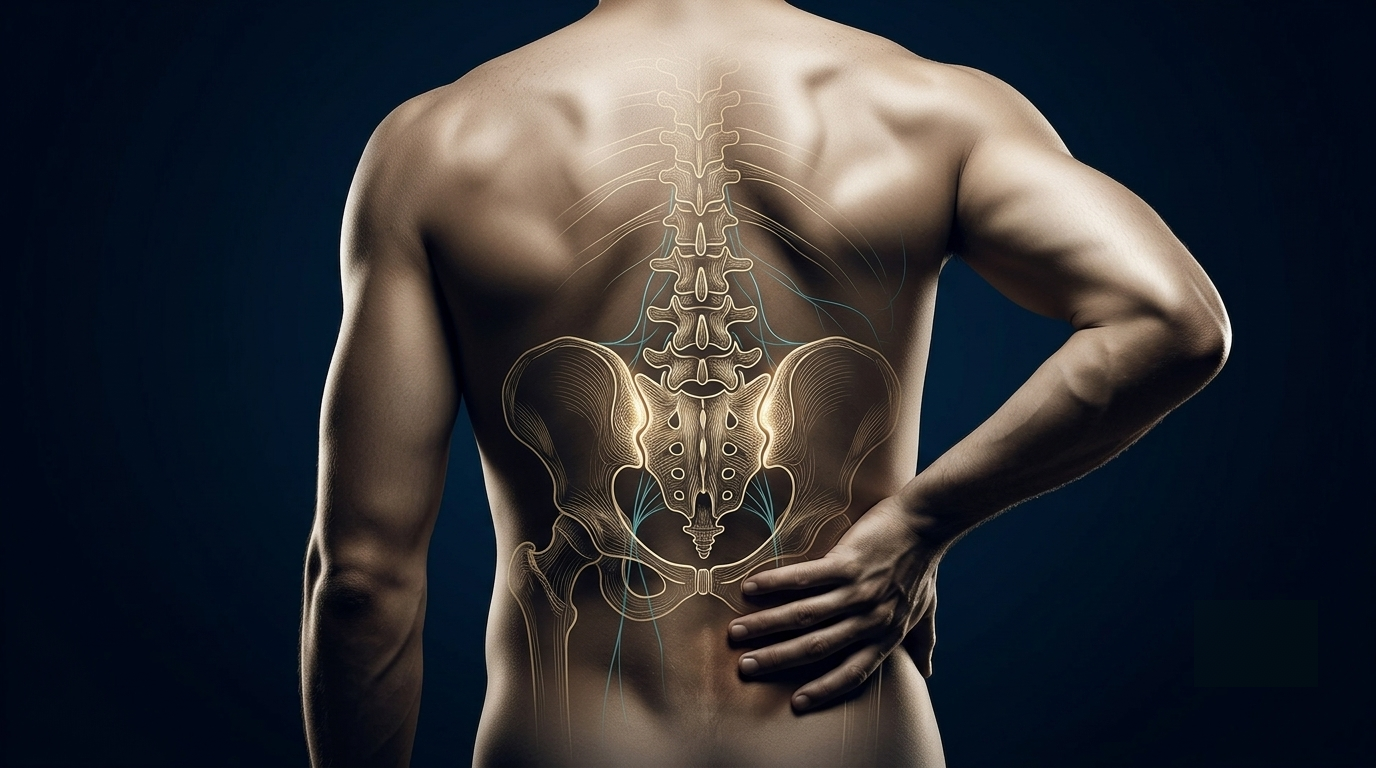
SI joint pain can feel like a deep ache in your low back or buttock that no amount of stretching seems to fix. The sacroiliac joint sits where your spine meets your pelvis, and when it is irritated or moving abnormally, even simple movements like standing from a chair or rolling over in bed can trigger a sharp catch.
This guide covers what causes SI joint dysfunction, how to distinguish it from sciatica, and which conservative and interventional treatments offer real relief without surgery.
What is sacroiliac joint pain
For quick relief from SI joint pain, alternate ice and heat for 15–20 minutes, take an over-the-counter anti-inflammatory like ibuprofen, and try a gentle knee-to-chest stretch to relax tight muscles around the pelvis. Avoid prolonged sitting and any activity that makes the pain worse. Longer-term relief depends on correcting muscle imbalances and stabilizing the pelvis, which usually involves targeted exercises, physical therapy, and sometimes interventional care.
The sacroiliac joint connects your sacrum (the triangular bone at the base of your spine) to your ilium (the large pelvic bone). You have one on each side. Every time you walk, sit, or stand, these joints transfer load between your upper body and your legs.
SI joint pain falls into two categories. Sacroiliac joint dysfunction refers to abnormal movement, either too much or too little. Sacroiliitis is inflammation of the joint itself, often tied to autoimmune conditions like ankylosing spondylitis. The distinction matters because mechanical dysfunction and inflammatory conditions require different treatment approaches.
Symptoms of sacroiliac joint dysfunction
SI joint pain usually shows up on one side. You might feel it deep in the low back, in the buttock, or wrapping around toward the hip. The pain can radiate into the groin or upper thigh, though it rarely travels below the knee. That pattern helps separate SI joint pain from sciatica, which typically shoots all the way down the leg.
Certain movements tend to provoke the joint:
- Standing from sitting: The transition loads the SI joint unevenly
- Climbing stairs: Each step creates rotational stress through the pelvis
- Prolonged positions: Sitting or standing too long stiffens the joint
- Rolling over in bed: Twisting can trigger a sharp catch
Long car rides often make things worse. Shifting your weight frequently or getting up to move around tends to help.
Common causes of sacroiliac pain
SI joint pain can develop from too much movement in the joint, too little movement, or direct irritation of the joint surfaces. Pinpointing the cause guides treatment.
Mechanical dysfunction and joint instability
When the muscles that stabilize your pelvis (glutes, core, hip flexors) are weak or imbalanced, the SI joint absorbs forces it was not built to handle alone. Hypermobility means the joint moves too much. Hypomobility means it is stuck. Both create pain, though through different mechanisms.
Sacroiliitis and inflammatory arthritis
Sacroiliitis is inflammation within the SI joint. It can occur with ankylosing spondylitis, psoriatic arthritis, reactive arthritis, or infection. Morning stiffness lasting more than 30 minutes, along with improvement from movement rather than rest, often points to an inflammatory cause.
Pregnancy and postpartum ligament laxity
During pregnancy, the hormone relaxin loosens pelvic ligaments to prepare for delivery. This creates SI joint instability that can persist for months after birth, especially if core and pelvic floor strength are not restored.
Trauma and repetitive stress injuries
A fall landing on the buttock, a car accident, or repetitive asymmetric loading (running on a sloped surface, golf swings) can irritate or damage the joint over time.
Adjacent segment overload after lumbar fusion
When lumbar vertebrae are surgically fused, the SI joint often compensates by absorbing extra mechanical stress. Pain below a fusion site frequently traces back to the SI joint.
How sacroiliac joint pain is diagnosed
SI joint pain mimics disc herniation, hip arthritis, and piriformis syndrome. Imaging alone cannot confirm the diagnosis, so clinical examination and diagnostic injection play a central role.
A physical exam typically includes provocative tests. The FABER test (flexion, abduction, external rotation) stresses the SI joint. Gaenslen’s test extends one hip while flexing the other. Compression and distraction tests apply direct pressure to the pelvis. When three or more of these tests reproduce your pain, SI joint involvement becomes more likely.
The gold standard for confirmation is a diagnostic injection. A physician injects local anesthetic directly into the SI joint under fluoroscopic or ultrasound guidance. If pain decreases by 75% or more, the SI joint is confirmed as the source. Imaging (X-ray, MRI, CT) can reveal inflammation or structural changes, but a normal scan does not rule out SI joint dysfunction. The joint can hurt without any visible abnormality.
Conservative sacroiliac pain treatment options
Most SI joint pain responds to non-surgical care when the underlying cause is addressed. Conservative treatment forms the foundation before considering injections or procedures.
Activity modification and postural correction
Avoiding prolonged sitting, crossing your legs, or standing with weight shifted to one side reduces asymmetric loading on the joint. Small adjustments, like using a lumbar support or alternating between sitting and standing, can make a noticeable difference over days and weeks.
Physical therapy and corrective exercise
Targeted exercises strengthen the glutes, core, and hip stabilizers. Bridges and pelvic tilts help stabilize the joint. Stretches like knee-to-chest and figure-4 relieve tension in the hamstrings and hip rotators. A physical therapist designs a program to correct the specific imbalances contributing to your pain.
Chiropractic care and manual mobilization
Hands-on techniques restore joint mobility, address pelvic alignment, and reduce muscle guarding around the SI joint. Manual care is particularly useful when the joint is hypomobile or when muscle spasm limits movement.
NSAIDs and short-term medication
Over-the-counter anti-inflammatories like ibuprofen or naproxen reduce inflammation and pain during flares. They are not a long-term solution, but they can help you participate in physical therapy more comfortably.
Sacroiliac support belts
An SI belt wraps around the pelvis and provides external compression. It limits excessive joint motion and is especially useful for hypermobility or pregnancy-related SI dysfunction.
How to calm a sacroiliac joint flare at home
When SI joint pain flares, a few immediate steps can reduce discomfort while you wait for professional care.
Treating the whole body is solely dependent upon having an intimate understanding of each of its individual parts. Mechanical dysfunction of non-traumatic origin is practically certain to cause — or be caused by — dysfunction in another region.
— Dr. Amin Javid1. Limit aggravating movements
Avoid stairs, prolonged sitting, and strenuous activities until the acute pain subsides. Gentle movement is still helpful; complete bed rest is not.
2. Apply ice or heat strategically
Alternate ice and heat for 15–20 minutes at a time. Ice reduces acute inflammation. Heat relaxes tight muscles. Some people respond better to one than the other, so experiment.
3. Use gentle positional relief
A single knee-to-chest stretch or supine figure-4 stretch can relax tight hip and gluteal muscles. Stop any movement that causes sharp or radiating pain.
4. Support the pelvis with a belt
An SI belt provides external compression to limit joint motion during a flare. It can be worn under clothing throughout the day.
5. Reintroduce mobility gradually
Once acute pain decreases, begin gentle movement to prevent stiffness. Avoid jumping back into full activity too quickly.
Interventional treatments for sacroiliac joint pain
When conservative care is not enough, interventional options can reduce inflammation or block pain signals without surgery.
Image-guided sacroiliac joint injections
A corticosteroid or anesthetic is injected directly into the SI joint under fluoroscopic or ultrasound guidance. The injection provides diagnostic confirmation and temporary pain relief, typically lasting weeks to months.
Radiofrequency ablation of the sacral nerves
Radiofrequency ablation uses heat to disrupt the nerve signals carrying pain from the SI joint. It is considered when injections provide temporary relief but pain returns. Relief can last six months to two years.
Regenerative therapy with PRP and prolotherapy
Platelet-rich plasma (PRP) or dextrose prolotherapy injections aim to stimulate tissue repair rather than mask symptoms. At Beverly Hills Spine & Rehabilitation, regenerative therapy is part of a comprehensive joint care approach for patients who want to address the underlying tissue damage.
Extracorporeal shockwave therapy
Non-invasive mechanical shockwaves stimulate blood flow and tissue healing around the joint. Shockwave therapy is one of the core services at our Beverly Hills practice for musculoskeletal pain that has not responded to standard conservative care.
When sacroiliac joint fusion surgery is appropriate
SI joint fusion is reserved for patients who have failed conservative and interventional treatments. Minimally invasive techniques stabilize the joint with small implants placed through a short incision.
Surgery carries risks, including infection, nerve injury, and adjacent segment stress. It is a last resort. At Beverly Hills Spine & Rehabilitation, we focus on non-surgical alternatives but collaborate with surgeons when fusion is the best path forward.
Preventing recurrence of sacroiliac pain
Long-term stability requires ongoing attention to the factors that caused the problem in the first place.
- Maintain core and gluteal strength: Continue the exercises learned in physical therapy
- Address postural habits: Avoid asymmetric sitting or standing patterns
- Manage load and activity: Progress exercise gradually; avoid sudden increases in training volume
- Periodic reassessment: If symptoms return, early intervention prevents chronic dysfunction
Finding root-cause relief in Beverly Hills
SI joint pain often connects to dysfunction elsewhere, in the hip, lumbar spine, or pelvic floor. At Beverly Hills Spine & Rehabilitation, Dr. Amin Javid’s whole-body biomechanics approach identifies the specific root cause rather than chasing symptoms.
A comprehensive evaluation determines whether your pain stems from mechanical dysfunction, inflammation, or compensation from another region. From there, an individualized treatment plan combines the conservative and interventional options most likely to restore function.
Learn more about non-surgical pain treatment options
FAQs about sacroiliac pain treatment
How long does sacroiliac joint pain last?
Duration varies by cause. Acute flares may resolve in days to weeks with conservative care. Chronic SI dysfunction can persist for months if the underlying mechanical or inflammatory cause is not addressed.
Is walking good or bad for sacroiliac joint pain?
Gentle walking on flat surfaces often helps by promoting circulation and preventing stiffness. Prolonged walking or uneven terrain can aggravate an inflamed SI joint, so shorter, more frequent walks are usually better tolerated.
Can a chiropractor treat sacroiliac joint pain?
Chiropractic care can restore SI joint mobility and pelvic alignment through manual techniques, especially when dysfunction stems from mechanical causes rather than systemic inflammation.
Is sacroiliac pain the same as sciatica?
They differ. SI joint pain typically stays in the low back, buttock, or upper thigh. Sciatica involves nerve compression and often radiates below the knee with numbness or tingling.
What sleeping position helps sacroiliac joint pain?
Side-sleeping with a pillow between the knees keeps the pelvis aligned and reduces SI joint stress. Sleeping on the stomach increases lumbar and pelvic strain and tends to worsen symptoms.
