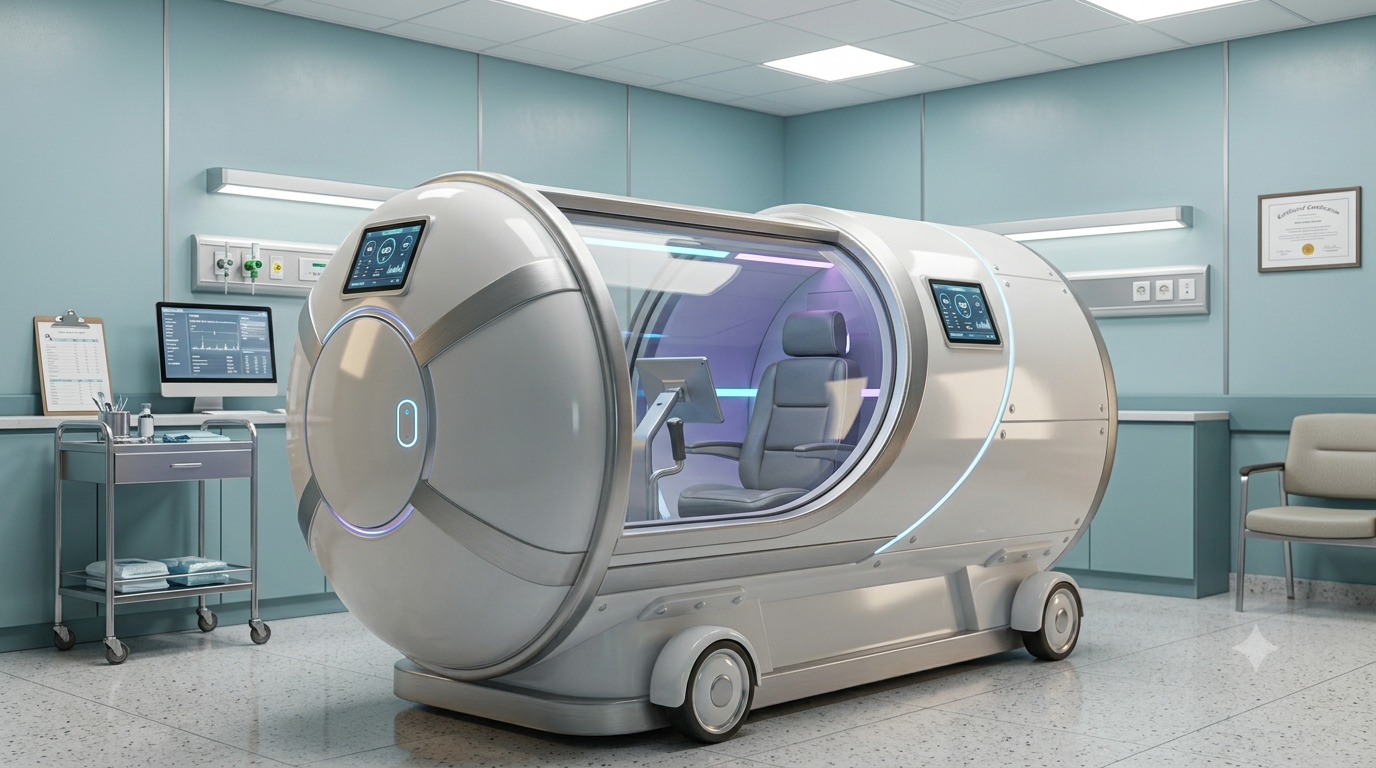
Mild hyperbaric oxygen therapy and traditional hyperbaric oxygen therapy share a name, but the similarities end there. The two treatments differ in pressure intensity, oxygen concentration, chamber construction, and clinical evidence, which means they accomplish different things for different purposes.
This guide breaks down exactly how mHBOT and HBOT compare, what conditions each is cleared to treat, and how to determine which option fits your situation.
What is hyperbaric oxygen therapy (HBOT)?
Hyperbaric oxygen therapy is a medical treatment where you breathe pure oxygen inside a pressurized chamber. The pressure inside the chamber is higher than normal atmospheric pressure, typically 2.0 to 3.0 ATA. ATA stands for atmospheres absolute, which is simply a way to measure pressure. At sea level, you’re at 1.0 ATA, so a chamber at 2.0 ATA has twice the normal pressure.
Why does pressure matter? When you increase atmospheric pressure while breathing pure oxygen, something interesting happens. Oxygen dissolves directly into your blood plasma rather than relying only on red blood cells to carry it. Your plasma becomes saturated with oxygen, and that oxygen can reach tissues that might otherwise be starved of it, particularly areas with poor blood flow or damaged vessels.
HBOT takes place in rigid, hospital-grade chambers made of steel or acrylic. A physician supervises each session, and trained operators manage the equipment. Sessions for approved medical conditions typically run 90 to 150 minutes, depending on what’s being treated.
What is mild hyperbaric oxygen therapy (mHBOT)?
Mild hyperbaric oxygen therapy uses a different setup entirely. The chambers are soft-sided, portable, and inflatable. They look a bit like large sleeping bags with zippers. The pressure inside tops out around 1.2 to 1.5 ATA, which is noticeably lower than medical-grade chambers.
Here’s another key difference: instead of breathing 100% pure oxygen, people in mHBOT chambers typically breathe ambient air (about 21% oxygen) or oxygen concentrated to around 95%. The combination of lower pressure and lower oxygen concentration changes what the therapy can accomplish at a physiological level.
You’ll find mHBOT offered in wellness spas, fitness centers, chiropractic offices, and even sold for home use. The experience is more accessible and less clinical than traditional HBOT, though the two therapies are often confused because of their similar names.
Key differences between mild HBOT and HBOT
The core distinction comes down to two variables: pressure intensity and oxygen concentration. Both affect how much oxygen actually reaches your tissues.
|
Feature |
Traditional HBOT | Mild mHBOT |
|
Pressure level |
2.0–3.0 ATA |
1.2–1.5 ATA |
| Oxygen concentration | 100% medical-grade |
21–95% |
|
Chamber type |
Rigid, hospital-grade |
Portable, soft-sided |
|
Typical session length |
90–150 minutes |
60 minutes or less |
| Medical oversight | Physician-supervised | Often unsupervised |
Let’s break down each of these differences.
Chamber pressure of 1.3 ATA vs 2.0 to 3.0 ATA
Traditional HBOT chambers pressurize to two or three times normal atmospheric pressure. At 2.0 ATA, you’re experiencing the same pressure you’d feel about 33 feet underwater. At 3.0 ATA, that’s equivalent to roughly 66 feet down.
Soft-sided mHBOT chambers can’t safely reach those pressures. Their flexible construction limits them to about 1.3 to 1.5 ATA. The physics here is straightforward: higher pressure forces more oxygen molecules into your blood plasma. At lower pressures, less oxygen dissolves, and the therapeutic effect diminishes accordingly.
Oxygen concentration delivered in each chamber
Medical HBOT delivers 100% pure oxygen through a mask or hood while you’re inside the pressurized chamber. When you combine pure oxygen with high pressure, your blood plasma becomes saturated with oxygen far beyond what normal breathing achieves.
mHBOT chambers typically deliver ambient air or oxygen concentrated to 95% at most. Even with concentrated oxygen, the lower chamber pressure limits how much oxygen actually dissolves into your tissues. The two variables work together, so reducing either one reduces the overall effect.
Hard shell vs soft shell chamber design
Hard-shell chambers are built from rigid materials that can withstand high pressures safely. They require specialized facilities, fire safety protocols, and trained operators. The construction itself enables the therapy to work at medical-grade levels.
Soft-shell chambers are inflatable and portable. They seal with a zipper and can be set up in a variety of locations. However, the flexible materials can’t structurally handle pressures above about 1.5 ATA. The chamber design places a ceiling on what the therapy can accomplish.
Session length and treatment frequency
mHBOT sessions typically last an hour or less. Traditional HBOT sessions run longer, often 90 to 150 minutes, because therapeutic protocols for approved conditions require sustained exposure at higher pressures.
Treatment frequency varies based on the condition. Some HBOT protocols call for daily sessions over several weeks. mHBOT providers often recommend ongoing sessions, though without standardized protocols guiding those recommendations.
FDA approved conditions treated by HBOT vs mHBOT
The regulatory picture differs considerably between these two therapies. Traditional HBOT has FDA clearance for specific medical conditions, while soft-sided chambers have much narrower approval.
Conditions HBOT is FDA cleared to treat
The Undersea and Hyperbaric Medical Society (UHMS) maintains a list of approved indications for HBOT. The FDA has cleared HBOT for conditions including:
Treating the whole body is solely dependent upon having an intimate understanding of each of its individual parts. Mechanical dysfunction of non-traumatic origin is practically certain to cause — or be caused by — dysfunction in another region.
— Dr. Amin Javid- Decompression sickness (commonly called “the bends”)
- Carbon monoxide poisoning
- Gas gangrene and certain severe anaerobic infections
- Diabetic foot ulcers and other non-healing wounds
- Radiation tissue damage from cancer treatment
- Severe burns
- Compromised skin grafts and flaps
Each condition on this list has clinical evidence supporting HBOT’s effectiveness at medical-grade pressures and oxygen concentrations.
Off-label and wellness uses of mild HBOT
Soft-sided chambers have FDA clearance for one condition: acute mountain sickness. That’s it.
However, mHBOT is widely marketed for athletic recovery, general fatigue, relaxation, anti-aging, and overall wellness. The gap between FDA clearance and marketing claims is worth understanding. Many conditions advertised for mHBOT do not have the same evidence base as HBOT’s approved indications.
Is mild hyperbaric oxygen therapy clinically proven?
The UHMS has noted that mHBOT lacks the evidence-based track record of traditional HBOT for serious medical conditions. The lower pressure and oxygen concentration mean less oxygen reaches hypoxic (oxygen-starved) tissues, which limits the therapeutic potential.
This doesn’t mean mHBOT has zero effects. Some people report feeling more energized or relaxed after sessions. What it does mean is that the clinical evidence supporting mHBOT for medical conditions is limited compared to traditional HBOT.
For someone considering hyperbaric therapy for a diagnosed condition, this distinction matters. The question isn’t whether mHBOT “does something,” but whether it does enough to address a specific medical problem.
Safety risks of soft shell and hard shell hyperbaric chambers
Both chamber types carry risks, though the nature of those risks differs.
Hard-shell chambers:
- Trained operators required: Staff manage pressurization, monitor patients, and follow fire safety protocols
- Physician oversight: A doctor supervises treatment and can respond to complications
- Established guidelines: The UHMS provides safety standards for medical HBOT facilities
- Known risks: Ear barotrauma (pressure-related ear discomfort) and, rarely, oxygen toxicity at very high pressures
Soft-shell chambers:
- Often unsupervised: Many sessions occur without medical personnel present
- Limited pressure regulation: Equipment is simpler than medical-grade chambers
- Home use concerns: The Wound Care Education Partners caution that many home users lack guidance on potential adverse events
- No standardized protocols: Without established guidelines, users may not recognize complications
The presence or absence of medical oversight is perhaps the most important safety variable between the two options.
Cost and session frequency for HBOT and mHBOT
Traditional HBOT is more expensive per session and typically requires treatment at a medical facility. Insurance may cover HBOT for FDA-approved conditions, though coverage varies by plan and diagnosis.
mHBOT sessions cost less, and some people purchase soft-sided chambers for home use. The lower cost reflects simpler equipment and the absence of medical oversight. It does not indicate equivalent therapeutic value.
Tip: When comparing costs, consider what you’re trying to accomplish. A less expensive therapy that doesn’t address your condition isn’t actually saving you money.
How to choose between mild HBOT and medical HBOT
Your decision depends on what you’re trying to accomplish and whether you have a diagnosed medical condition.
Medical HBOT may be appropriate when:
- You have a condition with FDA-cleared indications (wound healing, radiation injury, decompression sickness, etc.)
- Your physician recommends hyperbaric therapy as part of your treatment plan
- You want treatment at an accredited facility meeting UHMS standards
mHBOT may be considered when:
- You’re interested in general wellness support
- You understand the limited clinical evidence for medical conditions
- You’ve discussed your options with a healthcare provider
For any diagnosed medical condition, talking with a physician before pursuing either therapy is the appropriate first step. The right choice depends on your specific situation, not on marketing claims or general wellness trends.
Which oxygen therapy works best for musculoskeletal recovery
Patients recovering from injuries, tendon damage, or chronic musculoskeletal conditions often ask about hyperbaric therapy as part of their recovery plan. The answer depends on the specific condition and what the evidence supports for that condition.
At 90210doc, we evaluate each patient’s situation comprehensively before recommending any therapy. Our approach focuses on identifying the source of pain and dysfunction rather than applying treatments without clear indication. For patients considering hyperbaric options alongside other evidence-based treatments like spinal decompression, shockwave therapy, or regenerative medicine, a thorough clinical assessment helps determine what combination of therapies makes sense.
The goal is always to match the treatment to the problem, not to apply popular therapies without understanding whether they address your specific condition.
FAQs about mild HBOT vs HBOT
Is mild hyperbaric oxygen therapy worth the investment?
mHBOT costs less than medical HBOT per session, but the clinical evidence for treating medical conditions is limited. For wellness purposes, some people report subjective benefits like feeling more energized. However, subjective reports are not equivalent to the documented outcomes for FDA-cleared HBOT indications. Whether mHBOT is “worth it” depends on your goals and expectations.
How often should someone do mild hyperbaric oxygen therapy?
Session frequency varies by provider and intended use. Because mHBOT is not FDA-cleared for most marketed applications, there is no standardized protocol. Providers often recommend ongoing sessions, but those recommendations are not based on the same clinical evidence that guides medical HBOT protocols for approved conditions.
How long do the effects of hyperbaric oxygen therapy last?
Duration of benefit depends on the condition being treated and whether the patient receives medical-grade HBOT or mHBOT. For chronic conditions like non-healing wounds, ongoing sessions may be part of the treatment plan. For acute conditions like decompression sickness, a defined treatment course may resolve the issue. The answer varies considerably based on individual circumstances.
Can mild hyperbaric chambers be used safely at home?
Soft-sided chambers are sold for home use, and many people use them without incident. However, the Wound Care Education Partners caution that many home users lack guidance on potential adverse events and proper operation. Without medical oversight, users may not recognize complications or use the equipment correctly. If you’re considering a home chamber, understanding the limitations and risks is important.
